
Loading…
Loading…
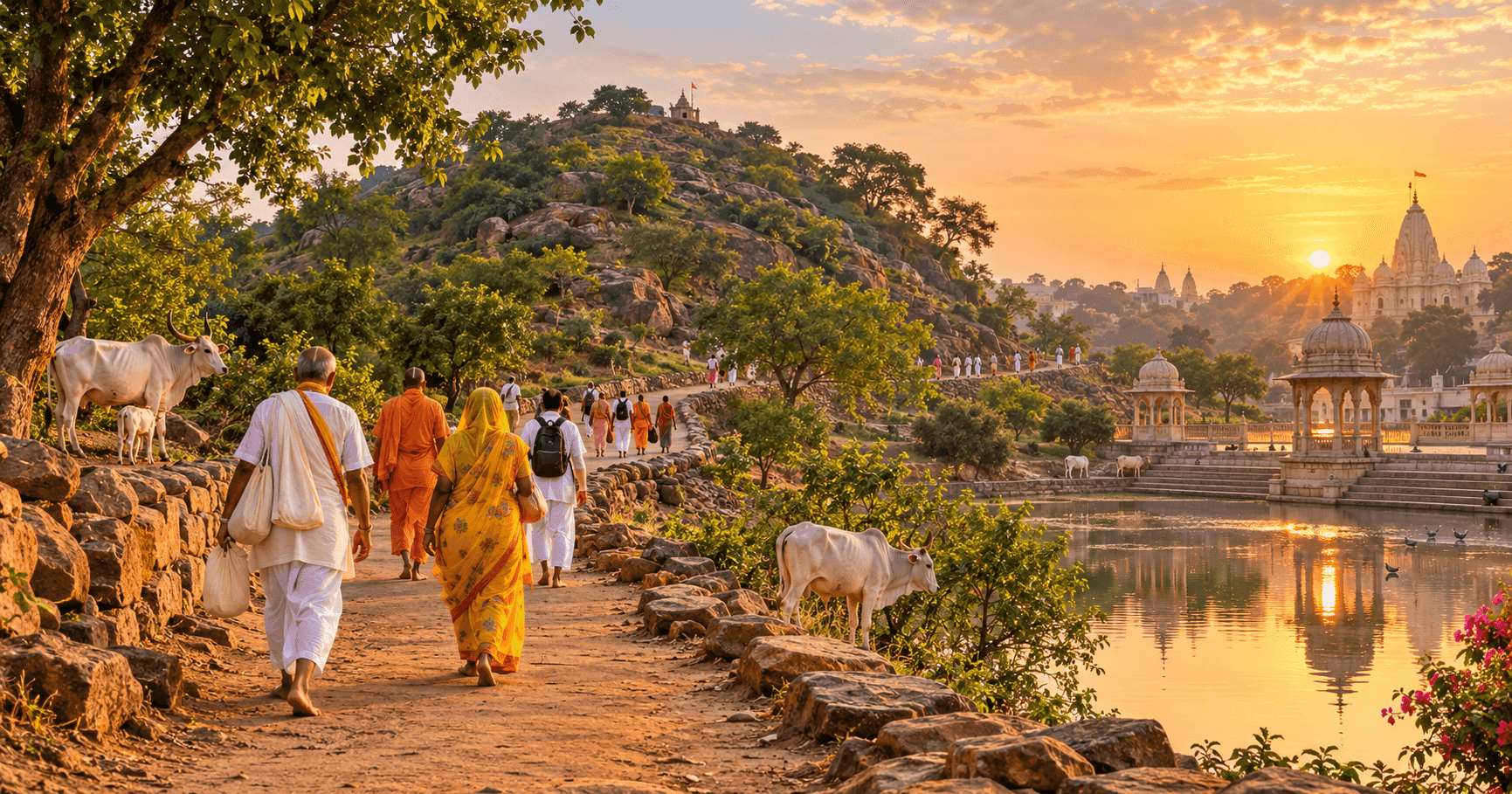
Plan your Govardhan Parikrama 2026 with a complete guide to the 21 km route, sacred temples, timings, pilgrimage rules and travel tips. Explore hotels in Mathura and Vrindavan with Sarovar Hotels for a comfortable Braj pilgrimage.
In the heart of Braj, about 26 km west of Mathura, rises a low, gentle ridge of sandstone that millions of devotees treat not as a hill but as a living form of Shri Krishna. This is Govardhan, also lovingly called Giriraj ji. According to the Bhagavata Purana, little Krishna lifted this hill on his finger for seven days to shelter the people and cows of Braj from the storms sent by Indra. Ever since, walking around Govardhan in a sacred circle, the Govardhan Parikrama, has been one of the most cherished acts of devotion in Braj.
Whether you are planning your very first Govardhan Parikrama, travelling for Govardhan Puja 2026, or simply want to experience the spiritual side of Mathura and Vrindavan, this guide covers everything you need to know: the Govardhan Parikrama route, total distance, how long it takes, the best time to start, the temples and kunds along the way, rules and etiquette, how to reach Govardhan from Delhi, and where to stay in Vrindavan with Sarovar Hotels for a comfortable parikrama trip.
Detail | Information |
|---|---|
Location | Govardhan, Mathura district, Uttar Pradesh |
Distance from Mathura | About 26 km |
Total parikrama distance | About 21 km (7 kos) |
Badi Parikrama | About 12 km |
Chhoti Parikrama | About 9 km |
Time on foot | Roughly 5 to 6 hours at a steady pace |
Common starting point | Daan Ghati Temple |
Traditional ending point | Mansi Ganga |
Direction | Clockwise, keeping the hill on your right |
Govardhan Puja 2026 | Monday, 9 November 2026 |
Sarovar stay nearby | Nidhivan Sarovar Portico Vrindavan |
A parikrama is a ritual circumambulation of a sacred place, done in a clockwise direction with the deity or holy site on your right. In Govardhan, the object of devotion is the hill itself. Giriraj Govardhan is a narrow sandstone ridge about 8 km long. It may not look like a mountain today, but for devotees it is one of the most sacred places in all of Braj.
The Govardhan Parikrama follows a path of roughly 21 km, traditionally described as 7 kos, around the entire hill. Along the way, pilgrims pass dozens of temples, sacred kunds (water tanks), groves and shrines, each connected to a story from Krishna's childhood and youth in Braj. Tradition says Govardhan has around seventy holy places and halts along the pilgrims' path.
Devotees believe that performing the parikrama with faith brings Krishna's blessings, fulfils wishes and purifies the heart. You will see people of every age on the route, from grandparents walking slowly with walking sticks, to young families with children, to sadhus chanting "Radhe Radhe" and "Giriraj Maharaj ki Jai".
Long ago, the people of Braj performed an annual puja to Indra, the king of the heavens and the god of rain, hoping for good monsoons. Young Krishna asked them to worship Govardhan Hill instead, since it was the hill that gave them grass for their cows, fruits, water and shelter. The villagers agreed and offered their puja and a parikrama to the hill.
Indra was furious and sent torrential rains and storms to flood Braj. To protect everyone, Krishna lifted Govardhan Hill on the little finger of his left hand and held it up like an umbrella for seven days. All the people and cows of Braj took shelter beneath it. Finally, Indra realised his mistake and bowed before Krishna.
This story is the reason we celebrate Govardhan Puja, also called Annakut, the day after Diwali, and it is the reason pilgrims have been walking around Giriraj ji for centuries.
The complete Govardhan Parikrama is about 21 km. It is usually understood as two connected loops:
Badi Parikrama (about 12 km): The larger loop, which usually begins at Daan Ghati and goes via Aanyor, Punchari and Jatipura before returning to Govardhan town.
Chhoti Parikrama (about 9 km): The smaller loop on the other side, which goes from Govardhan via Uddhav Kund, Radha Kund and Shyam Kund and Kusum Sarovar, and returns to Govardhan, ending at Mansi Ganga.
Some pilgrims and local guides say the walking distance, including detours to temples and kunds, comes closer to 23 km. If you plan to visit many shrines along the way, keep that in mind when planning your time and energy.
The route is mostly flat, with a soft earth walking path along much of the way, which is why so many devotees choose to walk it barefoot. You can technically start and end your parikrama at any point on the circuit after taking a sankalp (resolution), but most first-timers begin at Daan Ghati.
Here is how a typical full parikrama flows, starting from Daan Ghati and walking clockwise.
Daan Ghati is one of the two most important temples in Govardhan town. Its decorated facade shows Krishna lifting Govardhan Hill. Here, pilgrims offer milk to the sacred stone of Giriraj ji, take a sankalp, and begin the parikrama. The name "Daan Ghati" comes from a playful pastime in which Krishna and his friends asked the gopis for a "tax" (daan) of butter and milk as they passed this way.
As you walk towards Aanyor, the town gives way to quieter lanes, trees and small shrines. Aanyor is associated with the Annakut offering, where the people of Braj prepared a mountain of food for Govardhan. Several small temples and resting points line this stretch.
Govind Kund is a sacred tank where, according to tradition, Indra bathed Krishna with the heavenly cow Surabhi's milk after realising his mistake, and declared him "Govinda". It is a peaceful spot to pause, sip water and rest your feet.
Punchari lies near the far end of the hill. Tradition sometimes describes Govardhan as a peacock, with Mukharavind as its mouth and Punchari as its back and tail. The Punchari ka Lautha temple here is famous, and pilgrims stop to "mark their attendance" so that their parikrama is recorded.
Jatipura is home to Shri Mukharavind, considered the mouth or face of Giriraj ji. Devotees offer milk, sweets and flowers here, and it is one of the most important stops on the entire parikrama. Many pilgrims perform their main puja and offerings at Mukharavind.
From Jatipura, the Badi Parikrama route curves back towards Govardhan town, completing the larger 12 km loop. This is a good place to take a longer break, have chai and a light snack, and refill your water before starting the second loop.
The Chhoti Parikrama begins after you return to Govardhan. Uddhav Kund, on the right side of the parikrama marg just west of Govardhan, is associated with Uddhav, Krishna's friend and messenger, who came to Braj to console the gopis.
These twin sacred pools in the village of Arita, about 5 km from Govardhan, are among the holiest places in all of Braj. According to the story, after Krishna defeated the demon Arishtasura who had taken the form of a bull, Radha asked him to purify himself. Krishna created Shyam Kund, and Radha and her gopis dug Radha Kund with their bangles. Devotees believe that bathing here with faith brings divine love for Radha and Krishna. Take time to sit quietly on the ghats and enjoy the atmosphere.
Kusum Sarovar is a large, beautiful kund surrounded by elegant sandstone chhatris and steps leading down to the water. Its name comes from the flowers (kusum) that the gopis gathered here for Krishna. It is one of the most photogenic spots on the route, especially in the soft light of late afternoon.
Your parikrama traditionally ends at Mansi Ganga, the large kund in the centre of Govardhan town. According to tradition, Krishna created Mansi Ganga with the power of his mind (man) so that his parents could bathe in the Ganga without travelling far. Nearby is the Haridev temple, an important shrine on the parikrama path. Many devotees end their parikrama with a final offering to Giriraj ji here.
Along the way, you will also pass other kunds such as Sankarshan Kund, with a small temple of Balram beside it, and Airavat Kund, along with numerous small shrines and ashrams.
At a steady walking pace with short breaks, most people complete the 21 km Govardhan Parikrama in about 5 to 6 hours. If you stop at many temples and kunds, rest frequently, or walk barefoot, plan for 7 to 8 hours.
For first-timers, here is a practical guide:
Fit walkers: 5 to 6 hours for the full parikrama.
Families with children or senior citizens: 7 to 8 hours with breaks, or consider doing only the Chhoti Parikrama on foot.
By e-rickshaw: About 1.5 to 2 hours for the full circuit, including short darshan stops.
Early morning is the most comfortable time to start. Begin around sunrise and you will complete most of the walk before the afternoon heat. Many devotees also walk at night, especially on Purnima (full moon) and Ekadashi, when the route is lit and lively with chanting groups. Night parikrama has a special charm, but first-timers should walk with family or a group and stay on the main route.
October to March: The best months for parikrama, with pleasant temperatures. Govardhan Puja falls in this window.
Kartik month: One of the most spiritually significant times to visit Braj, overlapping with Diwali and Govardhan Puja. Expect large crowds and a joyful atmosphere.
Purnima days: Full moon days draw big crowds every month, and many devotees walk through the night.
Mudiya Purnima (Guru Purnima): A huge mela is held around Govardhan, with lakhs of pilgrims. It is an incredible experience, but very crowded and hot, as it falls in the monsoon season.
April to June: Very hot. If you visit in summer, walk only in the early morning or at night.
Govardhan Puja 2026 falls on Monday, 9 November 2026, the day after Diwali (8 November) and the day before Bhai Dooj. On this day, Govardhan sees one of its biggest gatherings of the year.
Here is what makes Govardhan Puja special in Govardhan and Vrindavan:
Annakut: Temples prepare a "mountain of food", often with dozens of vegetarian dishes, offered to Krishna and then distributed as prasad.
Giriraj abhishek: Devotees offer milk, curd and flowers to Giriraj ji at Daan Ghati, Mukharavind and other temples.
Cow worship: Cows, dear to Krishna, are bathed, decorated and worshipped.
Parikrama crowds: Lakhs of devotees walk the parikrama around the festival, so plan accordingly.
If you want to do the parikrama around Govardhan Puja 2026, arrive in Vrindavan a day early, start your walk before sunrise, and keep your belongings light. If you prefer a calmer experience, plan your parikrama a few days before Diwali or a week after Govardhan Puja.
The most common form. Many devotees walk barefoot as an act of devotion, but comfortable footwear is perfectly fine, especially for first-timers.
In this form, a devotee carries a pot of milk with a small hole and lets a thin stream of milk flow along the route while walking, as an offering to Giriraj ji. It is often done with family members helping to refill the pot.
The most demanding form. Devotees lie down in full prostration, mark the spot, stand up at the mark, and prostrate again, covering the entire route this way. It can take many days, weeks or even longer. Some devotees perform a 108 dandavat parikrama, where they do 108 prostrations at a single spot before moving forward.
Husband and wife perform the dandavat parikrama together, taking turns. It is considered an especially auspicious act of shared devotion.
For senior citizens, people with health limitations, or travellers short on time, e-rickshaws offer a way to complete the circuit while still stopping at major temples. Agree on the fare and the stops before you start.
Always walk clockwise, keeping Govardhan Hill on your right side.
Take a sankalp at the start of your parikrama, usually at Daan Ghati or wherever you begin.
Complete the circle you have resolved to do. If you have taken a sankalp for the full parikrama, try to complete it.
Do not take stones from Govardhan. Every stone of Giriraj is considered sacred. Do not remove or carry away any rocks from the hill.
Do not climb the hill. Devotees do not step on Giriraj ji out of respect.
Avoid leather items such as belts and wallets if you wish to follow traditional practice.
Keep it vegetarian and sattvik during your parikrama, and avoid tobacco and alcohol.
Greet fellow pilgrims with "Radhe Radhe". You will hear it everywhere.
Keep the route clean. Carry a small bag for your waste and dispose of it properly.
A refillable water bottle, and electrolyte sachets for long walks
Comfortable clothes in light, breathable fabric, and a shawl or light jacket for early mornings and nights in winter
Comfortable footwear or socks if you plan to walk barefoot on the softer stretches
A small bag with ID, some cash for offerings and snacks, and a phone with a charged power bank
Basic first aid: band-aids for blisters, pain relief spray, and any personal medicines
A small towel and sunscreen
A torch or phone light if you are walking at night
Start early. Sunrise starts are the most comfortable and give you time to rest at the end.
Pace yourself. It is not a race. Walk steadily, take short breaks and keep sipping water.
Walk in a group if possible, especially at night or during big festival days.
Eat light before starting. Have chai and a light breakfast; you will find food stalls along the route.
Use the e-rickshaw if needed. There is no shame in completing part of the route by e-rickshaw if you are tired.
Hire a local guide if you want to understand the stories behind each kund and shrine.
Keep your shoes safe. If you take off footwear at temples, use the stands provided or carry a small bag.
Plan your stay so that you can rest properly before and after the parikrama. A good night's sleep makes a big difference.
Govardhan is just one part of the Braj experience. Since you are coming all this way, plan a two to three day trip that combines:
Vrindavan: Banke Bihari Temple, Prem Mandir with its evening light show, ISKCON Vrindavan, Radha Raman Temple, Nidhivan and the Yamuna ghats.
Mathura: Shri Krishna Janmabhoomi, Dwarkadhish Temple and Vishram Ghat with its evening Yamuna Aarti.
Barsana and Nandgaon: The villages of Radha and Krishna, famous for their hilltop temples.
Day 1: Arrive and explore Vrindavan
Drive from Delhi to Vrindavan and check in at Nidhivan Sarovar Portico Vrindavan.
Visit ISKCON Vrindavan and Banke Bihari Temple in the afternoon.
End the day at Prem Mandir for the evening lights, then return to the hotel for a sattvik dinner.
Day 2: Govardhan Parikrama
Leave the hotel before sunrise and drive to Govardhan, about 21 km away.
Begin at Daan Ghati and complete the parikrama, ending at Mansi Ganga by late morning or early afternoon.
Return to the hotel to rest, then visit Shri Krishna Janmabhoomi in Mathura in the evening, or head back to Delhi.
Govardhan is roughly 150 to 170 km from Delhi, depending on your starting point. The fastest route is usually via the Yamuna Expressway towards Mathura and then on to Govardhan. The drive takes about 3 to 4 hours. From Vrindavan, Govardhan is around 21 to 25 km, and from Mathura about 26 km.
The nearest major railway station is Mathura Junction, about 26 km from Govardhan. Mathura is very well connected to Delhi, with many trains every day. From Mathura, take a cab or bus to Govardhan or Vrindavan.
The nearest airports are Agra and Delhi. Most travellers from outside the region fly to Delhi and drive to Vrindavan and Govardhan.
If you are staying in Vrindavan, book a cab for the morning of your parikrama. Ask the driver to drop you at Daan Ghati and pick you up at Mansi Ganga at a set time. On festival days, roads around Govardhan can be congested, so leave early.
Govardhan town itself has limited comfortable accommodation, and on festival days it becomes very crowded. Most travellers prefer to stay in Vrindavan, which is close enough to reach Govardhan early in the morning, and also lets you explore the temples of Vrindavan and Mathura.
If you are going from Delhi to Govardhan for the parikrama, Nidhivan Sarovar Portico Vrindavan is the hotel to stay in. It gives you a peaceful, comfortable base in Vrindavan, roughly 21 km from Govardhan, so you can start your parikrama early, return to rest and recover, and spend the rest of your trip visiting Vrindavan's temples.
SEO keyword addition:
For pilgrims comparing hotels in Mathura and Vrindavan, Sarovar Hotels offers two accommodation options in the Braj region. Alongside Nidhivan Sarovar Portico in Vrindavan, travellers can explore Skywings Sarovar Portico, Mathura, for a comfortable stay while visiting Govardhan, Shri Krishna Janmabhoomi and other sacred attractions.
Nidhivan Sarovar Portico Vrindavan is a 4-star contemporary hotel by Sarovar Hotels on Gopalgarh Tehra Road in Vrindavan. It is designed to capture the spirit of the sacred city while offering modern comfort.
Why it works for parikrama travellers:
Close to Vrindavan's top temples: Prem Mandir and ISKCON Vrindavan are only a few minutes' drive away.
Easy access to Govardhan: About 21 km to Govardhan, making a sunrise start very practical.
Comfortable rooms: Around 70 air-conditioned rooms with modern amenities, fine furniture and pleasing decor, perfect for resting tired feet after a 21 km walk.
Sattvik dining: The in-house restaurant, Tripti, serves a range of cuisines, and the Sattvik Thali is a must-try for pilgrims who prefer pure vegetarian food.
24-hour room service: Ideal if you are returning late from a night parikrama or leaving very early.
Wellness facilities: A health club with a fitness centre and steam room helps you relax and recover after the walk.
Free parking and Wi-Fi: Convenient for families driving from Delhi.
Event and meeting spaces: Banquet and meeting facilities make it a good choice for yatra groups, family gatherings and satsangs.
Families from Delhi who want a comfortable, clean and peaceful base for a weekend Braj yatra.
Senior citizens who need proper rest before and after the parikrama.
Groups and yatra parties looking for a well-organised stay with dining and meeting spaces.
First-time visitors who want to combine Govardhan Parikrama with Vrindavan and Mathura darshan.
For Govardhan Puja 2026 and the Diwali week, book your hotel in Vrindavan well in advance, as demand is very high.
Plan at least two nights: one for Vrindavan darshan and one for the parikrama day.
Ask the hotel team to help arrange an early-morning cab to Daan Ghati and an early breakfast or packed snack for the walk.
Braj is a paradise for vegetarian food lovers. After your parikrama, treat yourself to:
Kachori-sabzi and jalebi: The classic Braj breakfast, sold fresh at stalls near Govardhan and Vrindavan.
Lassi and rabri: Thick, creamy and perfect after a long walk.
Mathura peda: The most famous sweet of the region. Pick up a box to take home.
Makhan mishri: Butter with rock sugar, Krishna's favourite.
Temple prasad: Many temples, especially on Govardhan Puja, offer Annakut prasad.
Sattvik thali at Tripti: A wholesome meal at Nidhivan Sarovar Portico Vrindavan after your parikrama.
The Govardhan Parikrama is not just a long walk. It is a journey through the stories, faith and living traditions of Braj. As you walk past sacred kunds, hear chants of "Radhe Radhe" and see devotees offering milk to the stones of Giriraj ji, you begin to understand why this low sandstone hill is held so close to millions of hearts. For first-timers, a little planning goes a long way: start early, pace yourself, respect the customs and give yourself time to rest.
If you are travelling from Delhi for Govardhan Parikrama or Govardhan Puja 2026, make Nidhivan Sarovar Portico Vrindavan your base. Its comfortable rooms, sattvik dining and easy access to Govardhan, Prem Mandir and ISKCON make it the ideal hotel in Vrindavan for a peaceful and memorable Braj yatra with Sarovar Hotels.
Make your Govardhan Parikrama and Braj pilgrimage comfortable with Sarovar Hotels. Whether you're visiting Govardhan for the sacred 21 km parikrama, exploring Shri Krishna Janmabhoomi in Mathura or seeking blessings at the temples of Vrindavan, choose accommodation that suits your pilgrimage schedule.
Explore Nidhivan Sarovar Portico, Vrindavan, and Skywings Sarovar Portico, Mathura, for family stays, group pilgrimages and spiritual getaways.
For room reservations, accommodation enquiries, group bookings and assistance with your stay, contact the respective hotel teams.
Phone: +91 895 863 7000
Email: nsp@sarovarhotels.com
Phone: +91 565 490 0100
Email: spmt@sarovarhotels.com